Used Boat Buying: Keel Repair and Hull Fairing
Planning to fix a ding in the keel yourself? Here's a breakdown of the most important steps, as well as a list of must-have tools.
October 21, 2010
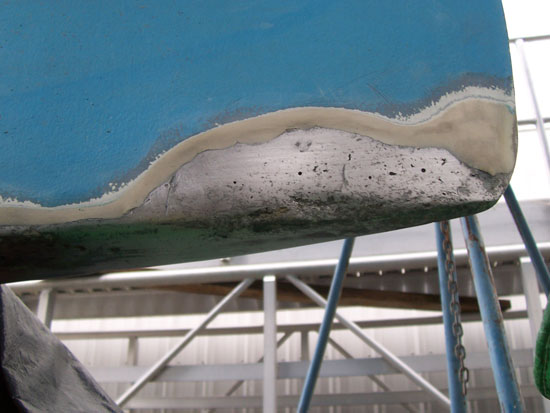
The loose filler is off, the exposed lead is roughed up, and the edges are feathered.
When you buy a boat, you buy an ongoing maintenance project. When you buy a well-used boat in June, you have to make a decision to make: Should you put it in the water, as is, and have fun with friends & family, or leave it in the boatyard and have “fun” by yourself – working in the summer heat?
We decided to splash the boat as soon as possible. It was in a storage yard an hour from our house, and there were only a few things that needed to be addressed before it was launched. The rest, we figured, could be done on its mooring, closer to home.
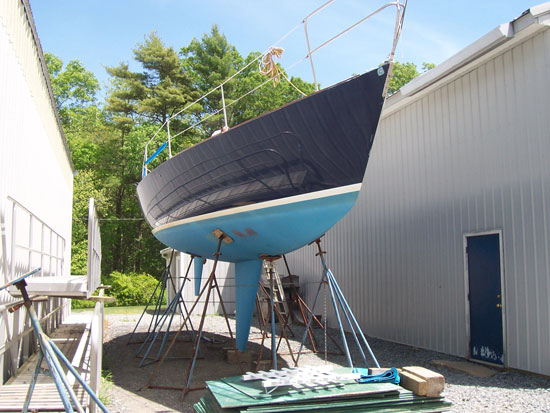
First on the list was to repair the bottom of the keel and smooth the underwater surfaces of the hull. The keel bottom was cracked and chipped and had the remains of a coral reef stuck to it. Unfortunately, it was also resting on two wood blocks, and the whole boat weighs over 10,000 lb.
The way around this is to use the adjustable boat stands to carefully tip the boat forward onto one block while you work on the aft section of the keel bottom, and then reverse the process to repair the forward section. (For obvious reasons, boatyards do not want owners messing with boat stands, so ask your yard for help if doing this.)
I had been through this exact fix-up process as part of a keel fairing project at my boatshop six years ago, and I still have many of the tools. So here’s a summary of the process and a list of the tools – so you can get the boat in the water ASAP!

Hold on tight and wear safety glasses – this grinder has lots of power.
1. Tarps Down
The first step was to put down some tarps to catch the dust and debris (a boatyard rule, and a good one).
2. Chip & Grind
After knocking off any loose filler, I used a 4 ½” grinder with a 50 grit disk to rough up the bare metal and feather the edges of the remaining filler. My grinder is a Milwaukee 6148. At 10,000 RPM, it is not a subtle tool. Keep it moving, and be aware of which direction it’s throwing the debris. Safety glasses are a must.
3. Seal with Vinylester
Next was an immediate sealing of the exposed lead with catalyzed Derakane 411-700 PAT Vinylester resin, applied with a foam brush. For small batches, I like to use a syringe for the MEKP catalyst. About 50 drops from a small tip will equal 1 cc, and the maximum amount — 3% — is around 1 cc per ounce. So if you have half of a 5 oz. cup to catalyze, you know that about 125 drops is as high as you can go. Mixing a small test cup before prepping the surfaces is a good way to be sure your catalyzation is right.
Epoxy could be used for this as well, (both are great adhesives), but Vinylester can be catalyzed to gel in 10 – 20 minutes so that filler can be added the same day. Epoxy would need to cure overnight, and would need to have its “amine blush” (greasy surface) removed by wetsanding before additional filler was added.
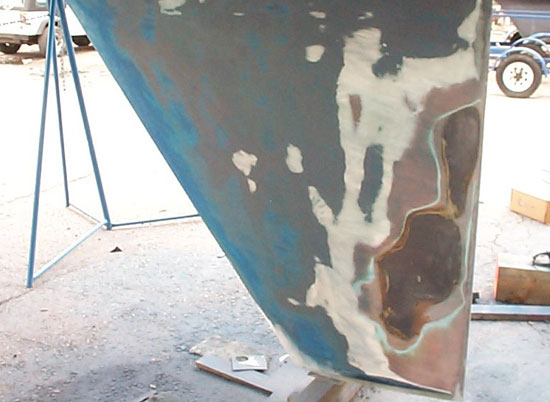
Grinding done, this keel is ready for filler and paint.
Polyester resin is not a good adhesive and I would never use it for this application.
4. Vinylester Filler
Once the resin was gelled, but still tacky on the surface, I mixed up some Vinylester filler and smoothed it over the area. I was a little early (the resin wasn’t quite kicked enough) and it started to sag, so I couldn’t put too much on. It’s probably better to keep each application under ¼” thick anyway, to prevent cracking from shrinkage. Another great thing about Vinylester fillers is that they act a bit like Bondo – with a “window” where they are cured, but not fully hard. A Surform tool or a rasp will do a lot of shaping before the filler gets rock hard.
5. Fairing & Smoothing
For actual sanding, I used a small, flat board with 60 and 80 grit paper, and then a Porter Cable 333, 5” Random Orbit (or “dual action”) sander attached to a Fein 9.55.13 dust collection vac. These sanders are used for finish sanding before painting because the pad turns at a slow rate and vibrates in small circles at the same time. A “DA,” as they’re often called (for “dual action”), will leave smaller scratches with a given grit of sandpaper than sanding in straight lines by hand.
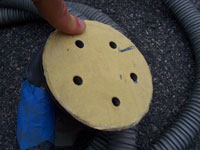
The hole pad (with pad break) and paper for dust collection
This sander has a hook & loop pad with 5 holes for sucking dust away from the surface. The paper was Norton’s 5 hole hook & loop paper in 60, 100, 150 and 320 grits. The hook & loop paper is super quick to change, and its adhesion to the pad isn’t affected by the dust.
The drawback to most DA’s is that they will start to spin like a rotary sander if they are lifted off the surface, or if you sand around a corner. This Porter Cable version has a pad break that keeps it from spinning out of control – much better!
The Fein vacuum is an awesome tool. The sander plugs right into it so that the vacuum turns on and off automatically with the sander. Some dust will escape, especially on curved surfaces, but most ends up in the vacuum – fantastic.
6. Painting
The rest of the bottom had blue VC Offshore bottom paint on it, so I used that here as well. I went lightly with a foam brush, and once it dried I smoothed out the paint gently with 320 grit on the Porter Cable sander.
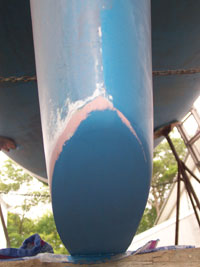
Forward end is smoothed, and paint is going on.
7. Hull Fairing
The hull surfaces had been stripped, barrier coated, and repainted sometime recently, but both applications were done with a roller, and there were some big bumps. I decided that all I could do at this point was run over the hull surfaces with 320 on the Porter Cable sander and knock off the high spots. Much of the “orange peel” from the roller was still there after sanding, but the bumps were gone and the results weren’t too bad for about an hour and a half’s work.
8. Tool List
After 14 years in my own shop, I’m tired of dust. I don’t want to breathe it, smell it, rub it out of my eyes, or wear it home to see my kids. I also don’t feel like getting electrocuted while working on a boat. Here’s what I used to do this cleanly and safely:
- A fabric suit (Tyvec or equivalent) – I don’t care if I’m sweating.
- Rubber work gloves – not just the disposable latex ones.
- Safety glasses. Especially when using the small grinder, stuff flies.
- A respirator. I hate the paper dust masks – they itch and the air goes right around them. I used a 3M 7502 mask with 2091 HEPA filters, and 6001 chemical cartridges (the cartridges may not be needed outside).
- A GFCI Plug. This is a Ground Fault Circuit Interrupter plug, similar to the outlets used in houses. It senses if there is any leakage of current to ground, and immediately opens the circuit. If your tools and extension cords aren’t perfect, or it’s at all damp where you’re working, this is a good thing to have.
Next up: Working with Boatyards
Editor’s Note: This article is part of an ongoing series about buying a used sailboat.
Read part 1, To Buy a Boat or Not to Buy a Boat
Read part 2, Used Boat Ads
Read part 3, How to Talk with the Broker
Read part 4, Looking at the Boat
Read part 5, Reaching an Agreement
Read part 6, Choosing a Name
 Paul Grimes is an engineer and marine surveyor living in Portsmouth, RI. Read his detailed reviews of the J/35 and Hobie 33.